When a game developer hires a visual artist or a sound designer, they can always check to see if they like the work with their own eyes and ears. Even if the dev doesn’t understand how to create that specific part of the work, they can still choose the art that better conveys their creative vision. But what happens when they can’t personally verify the quality of what goes into their game—say, like localization?
I know for a fact that there are devs out there who will only have their game localized into languages they speak, so as to ensure their essence has been preserved. Don’t get me wrong, I know what it’s like to be a perfectionist. When you are in a creative role (quite literally a creator) and you pour your heart and soul into what you’re doing, of course you want everything to go exactly as you envisioned it. Besides, translators get a bad rep due to that old misconception: “traduttore, traditore”, “translators are traitors”.
As tempting as it can be, leaving it to your fans is not the answer. At a first glance, it’s a win-win: you get an unofficial translation that you are not liable for, and they derive satisfaction from the experience of contributing to your work. However, there are ethical factors at play: whether they realize it or not, you are literally profiting from unpaid labor. A passionate community can surely do wonders in terms of effort and dedication, but it is not their specialty nor responsibility to make your game marketable in a specific country.
In Brazil, for example, only about 1% of the population speaks fluent English. That means your whole Brazilian fan base will only know your game through an unofficial, unverified text that you have absolutely no control over. Not that fan translations can’t be good; you just can’t expect them to be up to professional standards. And let’s not even get into machine translation and large language models. If you’re here, you’re probably well aware of my stance regarding letting machines handle feelings. Localization is an art, and art is exclusively made by humans.
Moving on, here are a few tips to help in case you feel wary of entrusting your words and worlds to a localization professional.
Find a good match
It all begins when you’re selecting a localization partner. The market is brimming with talented freelance translators for all languages, or, if you want to spare yourself the effort of managing multiple language pairs, you can always hire a collective or a boutique localization agency (because everyone knows bigger agencies do not offer good working conditions). You can find plenty of either option by simply googling it, or even better, searching on LinkedIn, since that’s where the translation/localization community is centered. Maybe ask your fellow game devs for referrals. Or you can ask me, since you’re here; I guarantee I have a talented colleague for any language you may need.
But finding someone willing to do the work is not enough, right? You still have to make sure they are serious, committed professionals. To get a sense of who they are and how much experience they have, you can email them asking for the usual stuff: CV, LinkedIn profile, website, rates and payment conditions… but most would argue that the most essential thing is a portfolio. You can even ask for translation samples and ask a bilingual friend you trust to judge them, if you want.
Don’t forget, however, that these are people, and the best approach is to talk to them and try to make a connection. You can figure out a lot from the first contact. Do they seem like a communicative person? Do they seem confident in their own skills? Are they assertive negotiators? Do they have experience or familiarity with that particular game genre? You can ask anything, as long as you’re respectful. If you don’t like someone, don’t give up; keep looking until you find a good match.
Provide good working conditions
This may seem obvious, but I had to include it anyway. Localizing takes a considerable amount of time and brainpower. There’s a strong connection between creativity and motivation, and people do their best work when they feel it’s a fair deal.
Make sure to look into fair rates (which are usually per-word, but you’re free to negotiate) and offer a reasonable deadline. If you want even better results, pay an extra professional for revision, and do not skip LQA (localization quality assurance). This is the stage when your linguist(s) will check the translations in-game after the first delivery and implementation. It’s crucial to see if there are any inconsistencies or UI issues. LQA prices are usually calculated on a per-hour rate.
If you don’t have the funds for it, no localization is better than half-assed localization that will make you go viral for all the wrong reasons. Having said that, sometimes people avoid thinking about localization because they think it will cost a lot more than it actually does. The solution is pretty simple: ask.
Feed us as much context as possible
I have never heard any of my colleagues complain about too much context. If you have any documents explaining the story or the lore of the universe you created, it’s always helpful to share them with your translators. I have worked in projects where I received detailed character descriptions with instructions regarding tone of voice, how the audience is supposed to perceive them at the beginning and end of their narrative arc, and even some of their secrets that were never mentioned in the game at all.
Tolkien himself wrote an entire guide to help translators understand how he came up with proper names like Rivendell and to encourage them to make use of transcreation. You can also create something like that–it doesn’t have to be anything fancy, just some general guiding notes can be immensely helpful. In fact, even a playlist can help convey a character’s personality or the feelings you want to instill with your story.
Last but not least, provide them with a game key to let them get acquainted with the game even before starting the translation process. Other than getting the vibe, it can also help prevent a lot of the issues that would come up later during LQA. If they have any questions, they can access the game and check for themselves to save you the time of answering queries. If you’re worried about leaking information about your unreleased game, you can always make the translators sign a non-disclosure agreement.
Translation notes & back translations
If you’re providing the text in a spreadsheet, make an extra column for your localizer to make translator’s notes on whatever expressions they feel the need to transcreate. That will give them the opportunity to explain anything they consider noteworthy. Or, if you want to know the exact meaning of every single translated sentence, you can request back translations. What is that, you ask? It’s when there’s an extra column for the translator to include a literal translation (that is, in the source language) of the localized text. In the very common occasion where a literal translation doesn’t make sense, such as in the case of idioms or slang, the translator will add a short explanation so you can approve it.
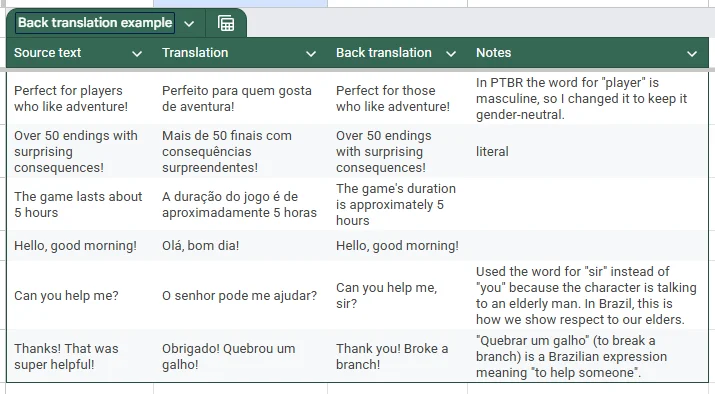
This way, even if you don’t speak the language, you can learn about the cultural nuances behind each sentence as you revise them. I wouldn’t say this is a common practice in the game localization world, but in other areas of translation, it’s fairly normal. You don’t have to request it for the whole game, but if you’re concerned about any particular sections that might require more creative solutions, this can be a good way to put your mind at ease. That is, as long as you’re willing to pay an extra fee for the extra work.
Answer questions
It is common practice to handle contracts, files and negotiation-related discussions via email to keep an official log for both parties. That being said, nothing prohibits using other channels of communication. For privacy reasons, I don’t give my phone number to clients, but there are other good options for instant messaging, such as Discord or Slack.
In addition to that, to facilitate communication when a game is being localized into multiple languages at once, it’s customary to use an online query sheet. Basically, it’s a spreadsheet where linguists and the game development/publishing team can communicate with each other more efficiently. Here’s an entertaining example I created specifically for this post, so I don’t break any NDAs:
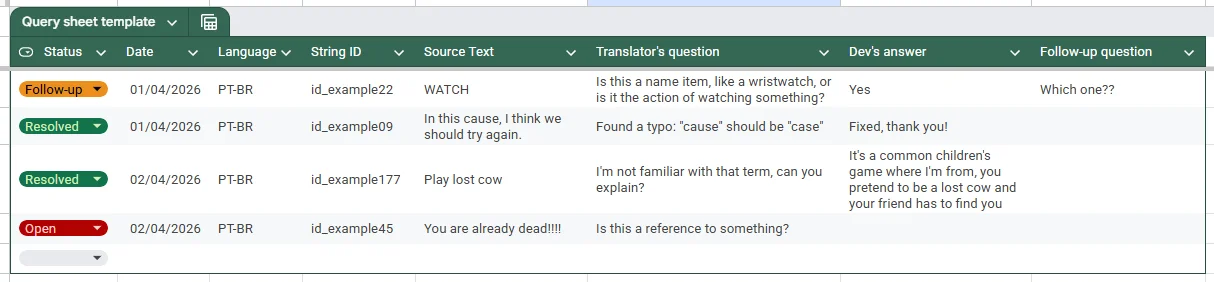
Even though we are a majority of introverts, an experienced translator likely won’t be afraid to ask you a ton of questions to make sure they understand the source material. The sheet can also be used to make suggestions, ask your opinion, or even report typos in your text, as a bonus. Be open to checking the queries often and answering each of them with patience and attention, and that’s a sure recipe for success.
Ask questions
I’m always thrilled when my clients show interest in my work. It’s what I spend most of my time doing, so I’m always happy when I get a chance to yap about it to a willing audience. As long as you’re respectful, I’ll answer a million questions to help you understand my translation choices, if you want. Plus, if you don’t agree with any of my choices, you can simply tell me and we’ll discuss an alternative that satisfies us both. After all, you’re the boss.
In conclusion
I’ll be honest with you: it does feel a little humiliating when someone says they don’t trust professional translators. We study really hard to be able to recreate the creator’s vision in the target language without intense monitoring. In fact, we’re used to doing it without any monitoring at all, since lots of clients don’t even bother answering our questions and providing quick and basic explanations. On the other hand, I understand why anyone would want to be cautious: professional localizations get their fair share of viral criticisms too. My view on that is that the translators are rarely the only ones at fault, as our profession is not taken seriously by most people, including the ones that lead the industry.
Regardless of that, I hope I have convinced you to consider giving a localizer a fighting chance. Your fans deserve the effort and investment, and your work deserves to reach as many people as possible. It is entirely possible to make your game available in languages you don’t speak without losing its essence, and now you know where to start. If you have any questions whatsoever, always feel free to contact me.
*Yes, I used an em dash in this post. No, it is not AI. None of my posts are or will ever be, thank you very much.